
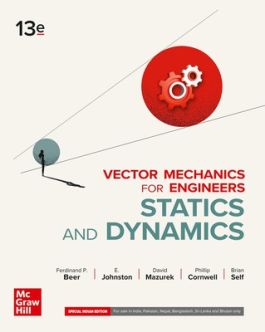
Vector Mechanics for Engineers: Statics and Dynamics
13th Edition
9364440110
·
9789364440110
© 2026 | Published: April 9, 2026
About the Book:This book, Vector Mechanics for Engineers helps students analyze problems in a simple and logical manner and then apply basic principles to their solutions, encouraging a strong conceptual understanding of these basic principles. Offer…
Read More
Chapter 1. Introduction
Chapter 2. Statics of Particles
Chapter 3. Rigid Bodies: Equivalent Systems of Forces
Chapter 4. Equilibrium of Rigid Bodies
Chapter 5. Distributed Forces: Centroids and Centers of Gravity
Chapter 6. Analysis of Structures
Chapter 7. Internal Forces and Moments
Chapter 8. Friction
Chapter 9. Distributed Forces: Moments of Inertia
Chapter 10. Method of Virtual Work
Chapter 11. Kinematics of Particles
Chapter 12. Kinetics of Particles: Newton's Second Law
Chapter 13. Kinetics of Particles: Energy and Momentum Methods
Chapter 14. Systems of Particles
Chapter 15. Kinematics of Rigid Bodies
Chapter 16. Plane Motion of Rigid Bodies: Forces and Accelerations
Chapter 17. Plane Motion of Rigid Bodies: Energy and Momentum Methods
Chapter 18. Kinetics of Rigid Bodies in Three Dimensions
Chapter 19. Mechanical Vibrations
Appendix A: Fundamentals of Engineering Examination
(Section and Problem Correlation)
Answers to Problems
Index
Properties of Geometric Shapes
Chapter 2. Statics of Particles
Chapter 3. Rigid Bodies: Equivalent Systems of Forces
Chapter 4. Equilibrium of Rigid Bodies
Chapter 5. Distributed Forces: Centroids and Centers of Gravity
Chapter 6. Analysis of Structures
Chapter 7. Internal Forces and Moments
Chapter 8. Friction
Chapter 9. Distributed Forces: Moments of Inertia
Chapter 10. Method of Virtual Work
Chapter 11. Kinematics of Particles
Chapter 12. Kinetics of Particles: Newton's Second Law
Chapter 13. Kinetics of Particles: Energy and Momentum Methods
Chapter 14. Systems of Particles
Chapter 15. Kinematics of Rigid Bodies
Chapter 16. Plane Motion of Rigid Bodies: Forces and Accelerations
Chapter 17. Plane Motion of Rigid Bodies: Energy and Momentum Methods
Chapter 18. Kinetics of Rigid Bodies in Three Dimensions
Chapter 19. Mechanical Vibrations
Appendix A: Fundamentals of Engineering Examination
(Section and Problem Correlation)
Answers to Problems
Index
Properties of Geometric Shapes
About the Book:
This book, Vector Mechanics for Engineers helps students analyze problems in a simple and logical manner and then apply basic principles to their solutions, encouraging a strong conceptual understanding of these basic principles. Offering a unified presentation of the principles of kinetics and a systematic problem-solving approach, the text has proven to be an effective teaching tool. The addition of Case Studies in every chapter are based on actual structures and systems, including failures, provide students with real-world engineering applications. And Sample Problems, liberally used at the end of each lesson, align with the SMART methodology to amplify the neat and orderly work students should cultivate in their own solutions.
Key Features:
1. Simplified Language: Concepts are introduced in the book in simple ways with steps being explained in detail.
2. Practical Applications – Early introduction of practical applications ensuring simplified understanding of simple concepts, further leading to learning complex concepts.
3. Problem Solving Approach –Solving Problems on Your Own, Concept Questions, Free Body and Impulse-Momentum Diagram Practice Problems etc. available at various sections in each chapter for students to practice.
4. Case Studies – Historical successes and failures of past designs discussed to gain insights on how engineers develop different products and structures.
This book, Vector Mechanics for Engineers helps students analyze problems in a simple and logical manner and then apply basic principles to their solutions, encouraging a strong conceptual understanding of these basic principles. Offering a unified presentation of the principles of kinetics and a systematic problem-solving approach, the text has proven to be an effective teaching tool. The addition of Case Studies in every chapter are based on actual structures and systems, including failures, provide students with real-world engineering applications. And Sample Problems, liberally used at the end of each lesson, align with the SMART methodology to amplify the neat and orderly work students should cultivate in their own solutions.
Key Features:
1. Simplified Language: Concepts are introduced in the book in simple ways with steps being explained in detail.
2. Practical Applications – Early introduction of practical applications ensuring simplified understanding of simple concepts, further leading to learning complex concepts.
3. Problem Solving Approach –Solving Problems on Your Own, Concept Questions, Free Body and Impulse-Momentum Diagram Practice Problems etc. available at various sections in each chapter for students to practice.
4. Case Studies – Historical successes and failures of past designs discussed to gain insights on how engineers develop different products and structures.