
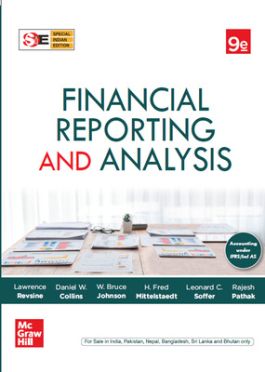
Financial Reporting and Analysis
9th Edition
9364449762
·
9789364449762
© 2026 | Published: February 16, 2026
About the Book:The book follows a critical thinking approach to understanding how financial information is created, reported, and used in decision-making. It provides a practical framework to evaluate management’s accounting choices and their impac…
Read More
Chapter 1 The Economic and Institutional Setting for Financial Reporting
Chapter 2 Accrual Accounting and Income Determination
Chapter 3 Revenue Recognition
Chapter 4 Structure of the Balance Sheet and Statement of Cash Flows
Chapter 5 Accounting Changes and Restatements, Financial Statement Notes, and Non-GAAP Metrics
Chapter 6 Essentials of Financial Statement Analysis
Chapter 7 Inventories
Chapter 8 Long-Lived Assets
Chapter 9 Financial Instruments and Liabilities
Chapter 10 Financial Reporting for Leases
Chapter 11 Income Tax Reporting
Chapter 12 Financial Reporting for Owners’ Equity
Chapter 13 Intercorporate Investments
Chapter 14 Accounting for Foreign Operations and Segment Reporting
Summary
Exercises
Problems / Discussion Questions
Cases
Chapter 2 Accrual Accounting and Income Determination
Chapter 3 Revenue Recognition
Chapter 4 Structure of the Balance Sheet and Statement of Cash Flows
Chapter 5 Accounting Changes and Restatements, Financial Statement Notes, and Non-GAAP Metrics
Chapter 6 Essentials of Financial Statement Analysis
Chapter 7 Inventories
Chapter 8 Long-Lived Assets
Chapter 9 Financial Instruments and Liabilities
Chapter 10 Financial Reporting for Leases
Chapter 11 Income Tax Reporting
Chapter 12 Financial Reporting for Owners’ Equity
Chapter 13 Intercorporate Investments
Chapter 14 Accounting for Foreign Operations and Segment Reporting
Summary
Exercises
Problems / Discussion Questions
Cases
About the Book:
The book follows a critical thinking approach to understanding how financial information is created, reported, and used in decision-making. It provides a practical framework to evaluate management’s accounting choices and their impact on valuation, contracts, and corporate performance. With real-world examples and emphasis on avoiding misuse of financial data, the book is a valuable resource for those seeking deep understanding of the decision-making power of financial statements.
Deliberations from new Indian Accounting Standards (IndASs) on various topics are integrated. Exercises using Indian companies and datasets aim to familiarize students with the business context they are most likely to encounter. Select additions across chapters extend the discussion and enrich students’ understanding of key concepts.
Blending perspectives from accounting, finance, and economics, it is ideal for MBA students, analysts, auditors, and others who rely on financial statements for informed business decisions.
Key Features:
1. Critical Thinking Approach: Encourages deeper analysis of accounting choices and their implications.
2. Real-World Applications: Includes examples and scenarios relevant to Indian and global business environments.
3. IndAS Inclusion: Indian text updated with IndAS application wherever required
4. Focus on Practical Use: Designed for users of financial statements -analysts, auditors, investors, and board members.
5. Rich Pedagogy: Includes boxed readings, recap boxes, icons, end-of-chapter elements etc.
The book follows a critical thinking approach to understanding how financial information is created, reported, and used in decision-making. It provides a practical framework to evaluate management’s accounting choices and their impact on valuation, contracts, and corporate performance. With real-world examples and emphasis on avoiding misuse of financial data, the book is a valuable resource for those seeking deep understanding of the decision-making power of financial statements.
Deliberations from new Indian Accounting Standards (IndASs) on various topics are integrated. Exercises using Indian companies and datasets aim to familiarize students with the business context they are most likely to encounter. Select additions across chapters extend the discussion and enrich students’ understanding of key concepts.
Blending perspectives from accounting, finance, and economics, it is ideal for MBA students, analysts, auditors, and others who rely on financial statements for informed business decisions.
Key Features:
1. Critical Thinking Approach: Encourages deeper analysis of accounting choices and their implications.
2. Real-World Applications: Includes examples and scenarios relevant to Indian and global business environments.
3. IndAS Inclusion: Indian text updated with IndAS application wherever required
4. Focus on Practical Use: Designed for users of financial statements -analysts, auditors, investors, and board members.
5. Rich Pedagogy: Includes boxed readings, recap boxes, icons, end-of-chapter elements etc.
