
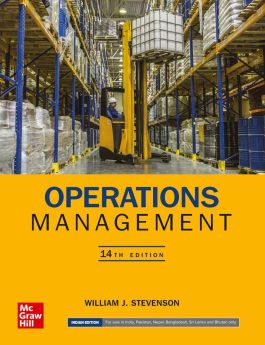
Operations Management
14th Edition
9378520030
·
9789378520037
© 2027 | Published: June 26, 2026
Overview:This beloved and market-leading Operations Management book has been completely updated in the 14th edition and provides a clear presentation of the field of Operations Management with current real-world examples and thoughtful student pedago…
Read More
Chapter 1: Introduction to Operations Management
Chapter 2: Competitiveness, Strategy, and Productivity
Chapter 3: Forecasting
Chapter 4: Product and Service Design
SUPPLEMENT TO CHAPTER 4: Reliability
Chapter 5: Strategic Capacity Planning for Products and Services
SUPPLEMENT TO CHAPTER 5: Decision Theory
Chapter 6: Process Selection and Facility Layout
Chapter 7: Work Design and Measurement
SUPPLEMENT TO CHAPTER 7: Learning Curves
Chapter 8: Location Planning and Analysis
Chapter 9: Management of Quality
Chapter 10: Quality Control
Chapter 11: Aggregate Planning and Master Scheduling
Chapter 12: Inventory Management
Chapter 13: MRP and ERP
Chapter 14: JIT and Lean Operations
SUPPLEMENT TO CHAPTER 14: Maintenance
Chapter 15: Supply Chain Management
Chapter 16: Scheduling
Chapter 17: Project Management
Chapter 18: Management of Waiting Lines
Chapter 19: Linear Programming
Appendix A: Answers to Selected Problems
Appendix B: Tables
Appendix C: Working with the Normal Distribution
Appendix D: Ten Things to Remember Beyond the Final Exam
Chapter 2: Competitiveness, Strategy, and Productivity
Chapter 3: Forecasting
Chapter 4: Product and Service Design
SUPPLEMENT TO CHAPTER 4: Reliability
Chapter 5: Strategic Capacity Planning for Products and Services
SUPPLEMENT TO CHAPTER 5: Decision Theory
Chapter 6: Process Selection and Facility Layout
Chapter 7: Work Design and Measurement
SUPPLEMENT TO CHAPTER 7: Learning Curves
Chapter 8: Location Planning and Analysis
Chapter 9: Management of Quality
Chapter 10: Quality Control
Chapter 11: Aggregate Planning and Master Scheduling
Chapter 12: Inventory Management
Chapter 13: MRP and ERP
Chapter 14: JIT and Lean Operations
SUPPLEMENT TO CHAPTER 14: Maintenance
Chapter 15: Supply Chain Management
Chapter 16: Scheduling
Chapter 17: Project Management
Chapter 18: Management of Waiting Lines
Chapter 19: Linear Programming
Appendix A: Answers to Selected Problems
Appendix B: Tables
Appendix C: Working with the Normal Distribution
Appendix D: Ten Things to Remember Beyond the Final Exam
Overview:
This beloved and market-leading Operations Management book has been completely updated in the 14th edition and provides a clear presentation of the field of Operations Management with current real-world examples and thoughtful student pedagogy. The comprehensive breadth of content is presented in more modular flexible chapters, so it may be used for different course levels ranging from undergrad to executive education. That flexibility allows for the choice of more or less quantitative material and flexibility in order of presentation since chapters do not depend on sequence. The topics covered include both strategic issues and practical applications. Among the topics are forecasting, product and service design, capacity planning, management of quality and quality control, inventory management, scheduling, supply chain management, and project management.
Key Features:
1. Comprehensive coverage of operations management concepts for both manufacturing and service industries.
2. Real-world case studies and examples that connect theory with business practice.
3. Step-by-step explanations supported by solved examples and numerical problems.
4. End-of-chapter review questions, exercises, and case analyses to reinforce learning.
This beloved and market-leading Operations Management book has been completely updated in the 14th edition and provides a clear presentation of the field of Operations Management with current real-world examples and thoughtful student pedagogy. The comprehensive breadth of content is presented in more modular flexible chapters, so it may be used for different course levels ranging from undergrad to executive education. That flexibility allows for the choice of more or less quantitative material and flexibility in order of presentation since chapters do not depend on sequence. The topics covered include both strategic issues and practical applications. Among the topics are forecasting, product and service design, capacity planning, management of quality and quality control, inventory management, scheduling, supply chain management, and project management.
Key Features:
1. Comprehensive coverage of operations management concepts for both manufacturing and service industries.
2. Real-world case studies and examples that connect theory with business practice.
3. Step-by-step explanations supported by solved examples and numerical problems.
4. End-of-chapter review questions, exercises, and case analyses to reinforce learning.