
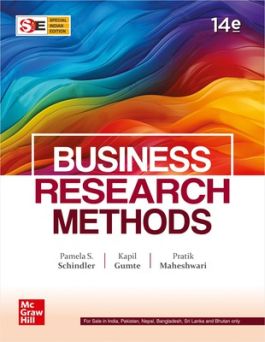
Business Research Methods
14th Edition
9364441222
·
9789364441223
© 2026 | Published: December 10, 2025
About the Book:This edition emphasizes clarity, speed, and quality in business research, addressing the evolving needs of the industry and organizations adapting to technological advancements and post-COVID-19 challenges. It integrates foundational c…
Read More
PART I: Building the Foundation for Research
1. Research Foundations and Fundamentals
2. The Research Process: An Overview
3. Stage 1: Clarify the Research Question
PART II: The Design of Business Research
4. Stage 2: Research Design, An Overview
5. Stage 2: Sampling Design
Appendix: Calculate the Sample Size
6. Stage 2: Data Collection Design: Qualitative Research
7. Stage 2: Data Collection Design: Observation Research
8. Stage 2: Data Collection Design: Experiments
9. Stage 2: Data Collection Design: Survey Research
PART III: Measurement
10. Stage 3: Measurement Foundations
11. Stage 3: Measurement Questions
Appendix: Sources of Measurement Questions
12. Stage 3: Measurement Instruments
Part IV: Collect, Prepare, and Examine the Data
13 Stage 3: Collect, Prepare, and Examine Data
Appendix: Better Tables
Appendix: Review: Describing Data Statistically
Part V: Analyze and Interpret Data
14. Stage 4: Hypothesis Testing
15. Stage 4: Measures of Association
Part VI: Report the Research
16. Stage 5: Research Reports: Support Insights and Recommendations
Appendix: Better Reports
Part VII: Research Project Overview
17. An Integrated Example
1. Research Foundations and Fundamentals
2. The Research Process: An Overview
3. Stage 1: Clarify the Research Question
PART II: The Design of Business Research
4. Stage 2: Research Design, An Overview
5. Stage 2: Sampling Design
Appendix: Calculate the Sample Size
6. Stage 2: Data Collection Design: Qualitative Research
7. Stage 2: Data Collection Design: Observation Research
8. Stage 2: Data Collection Design: Experiments
9. Stage 2: Data Collection Design: Survey Research
PART III: Measurement
10. Stage 3: Measurement Foundations
11. Stage 3: Measurement Questions
Appendix: Sources of Measurement Questions
12. Stage 3: Measurement Instruments
Part IV: Collect, Prepare, and Examine the Data
13 Stage 3: Collect, Prepare, and Examine Data
Appendix: Better Tables
Appendix: Review: Describing Data Statistically
Part V: Analyze and Interpret Data
14. Stage 4: Hypothesis Testing
15. Stage 4: Measures of Association
Part VI: Report the Research
16. Stage 5: Research Reports: Support Insights and Recommendations
Appendix: Better Reports
Part VII: Research Project Overview
17. An Integrated Example
About the Book:
This edition emphasizes clarity, speed, and quality in business research, addressing the evolving needs of the industry and organizations adapting to technological advancements and post-COVID-19 challenges. It integrates foundational concepts, advanced methodologies, and real-world applications enriched with examples like Snapshots, Closeups, and PicProfiles, making new material accessible and relevant for students and professionals alike.
The Special Indian Edition supplements the global framework with localized datasets, cases, and topics tailored to India’s diverse business environment. With industry-specific examples from FMCG, e-commerce, renewable energy, and more, it bridges theory and practice, preparing readers for internships, dissertations, and real-world challenges in management and research.
Key Features:
1. Experiential Learning Approach. Chapters conclude with at least one end-to-end Indian case study with real or simulated datasets (Excel/SPSS formats), encouraging students to apply analytical methods such as exploratory factor analysis (EFA), regression, correlation, and hypothesis testing using practical tools.
2. Visual learners need pictures, diagrams, and graphs to clarify and reinforce the concept: 31 fully integrated research processes exhibits link concepts within stand-alone chapters.
3. Snapshots, CloseUps, and PicProfiles capture how research is being conducted in a variety of different industries
4. Multipurpose Discussion Questions. These serve as review for students, as testing exercises, or as options for lively class discussions, as many are pulled from the headlines reflecting real business situations.
5. Each stage of the research process- problem identification, design, sampling, data collection, and analysis has been enriched with India-centric examples and datasets.
This edition emphasizes clarity, speed, and quality in business research, addressing the evolving needs of the industry and organizations adapting to technological advancements and post-COVID-19 challenges. It integrates foundational concepts, advanced methodologies, and real-world applications enriched with examples like Snapshots, Closeups, and PicProfiles, making new material accessible and relevant for students and professionals alike.
The Special Indian Edition supplements the global framework with localized datasets, cases, and topics tailored to India’s diverse business environment. With industry-specific examples from FMCG, e-commerce, renewable energy, and more, it bridges theory and practice, preparing readers for internships, dissertations, and real-world challenges in management and research.
Key Features:
1. Experiential Learning Approach. Chapters conclude with at least one end-to-end Indian case study with real or simulated datasets (Excel/SPSS formats), encouraging students to apply analytical methods such as exploratory factor analysis (EFA), regression, correlation, and hypothesis testing using practical tools.
2. Visual learners need pictures, diagrams, and graphs to clarify and reinforce the concept: 31 fully integrated research processes exhibits link concepts within stand-alone chapters.
3. Snapshots, CloseUps, and PicProfiles capture how research is being conducted in a variety of different industries
4. Multipurpose Discussion Questions. These serve as review for students, as testing exercises, or as options for lively class discussions, as many are pulled from the headlines reflecting real business situations.
5. Each stage of the research process- problem identification, design, sampling, data collection, and analysis has been enriched with India-centric examples and datasets.
